



Blog
4 June 2026Is Swiss Politics Becoming More Emotional? Evidence from 180,000 Parliamentary Speeches
Emotion in Swiss Parliamentary Debate: An NLP Analysis
A research collaboration between the University of Zurich student project and DemoSquare.
Switzerland is known for its direct democracy, neutrality, and concordance system. Research has shown a rise in emotionality and polarization in France, the US, the UK, and the EU. How has Switzerland fared? We applied natural language processing to more than 180,000 Swiss parliamentary speeches, using the Multilingual ParlaCAP model for topic classification alongside emotion analysis with GPT-4o-mini, enabling simultaneous tracking of thematic content and emotional tone across German, French, and Italian debates. First, we distinguished between rational and emotional speeches, then we classified the emotional speeches across eight dimensions: anger, hope, enthusiasm, fear, joy, sadness, pride, and disgust.
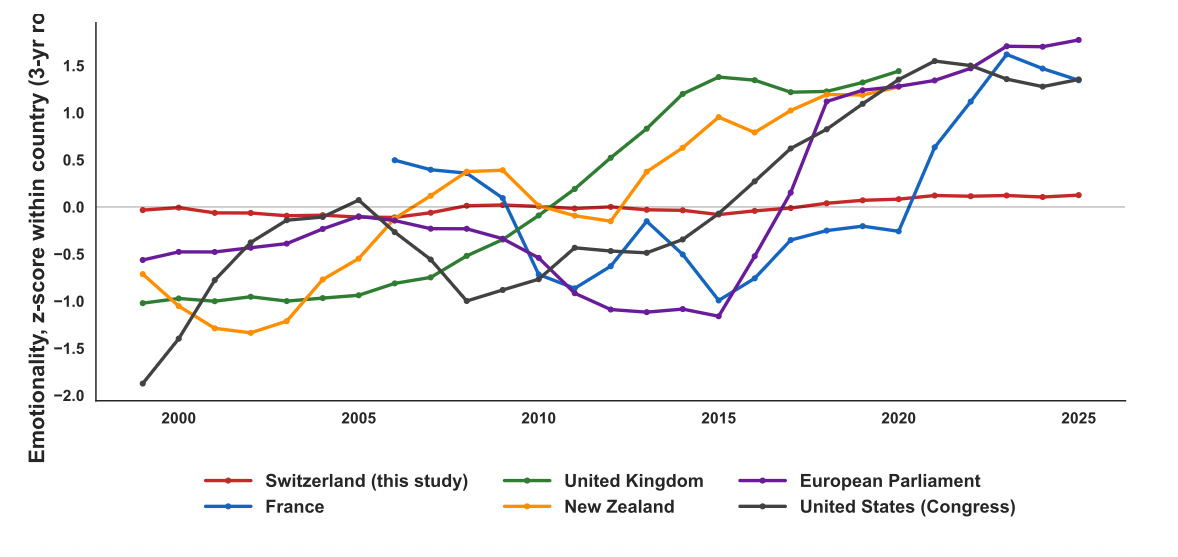
After an initial decline in the early 2000s, emotionality in the National Council has risen, though only by 3.7 percentage points between the first and most recent four-year averages (from 17.9% to 21.6%), far less dramatically than in comparable parliaments. The SVP is the main driver of this evolution: the share of its speeches classified as emotional has nearly doubled, rising from around 16% in 2000–2005 to 29% in 2020–2025 — a +76% relative increase. Within emotional speeches, the SVP stands out for an extreme profile: anger dominates (73%), far ahead of enthusiasm (16%), and it is the only party where fear consistently outranks hope. Among the Greens, by contrast, emotionality has receded by about a third (from 39% to 29% of speeches), shifting toward a more deliberative register. The FDP remains low and stable (around 10%), while the SP and Mitte show modest increases (+25% and +17% in relative terms). One often-overlooked finding: anger is not the SVP's monopoly — it also dominates among the SP, the Greens, and the FDP (52% to 59% of emotional speeches). The Green Liberals are the only party where enthusiasm (42%) outweighs anger (38%).
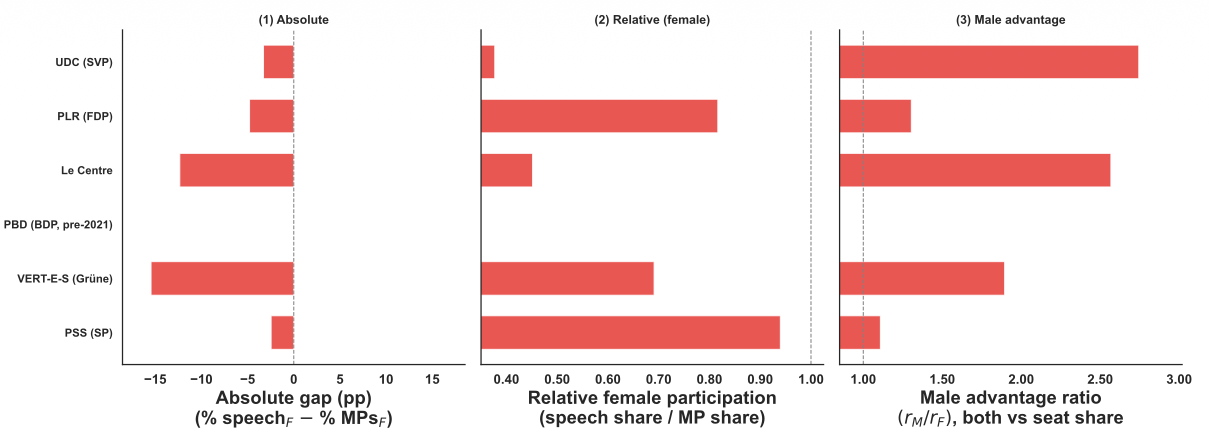
Anger leads in most parties, with enthusiasm a close second across the chamber. Beyond party patterns, the data reveals distinct gender dynamics. Men exhibit heightened emotional expression in international affairs and immigration, while women show greater engagement in social welfare, health, and labour. Civil rights elicits stronger emotional responses from both genders than any other topic.
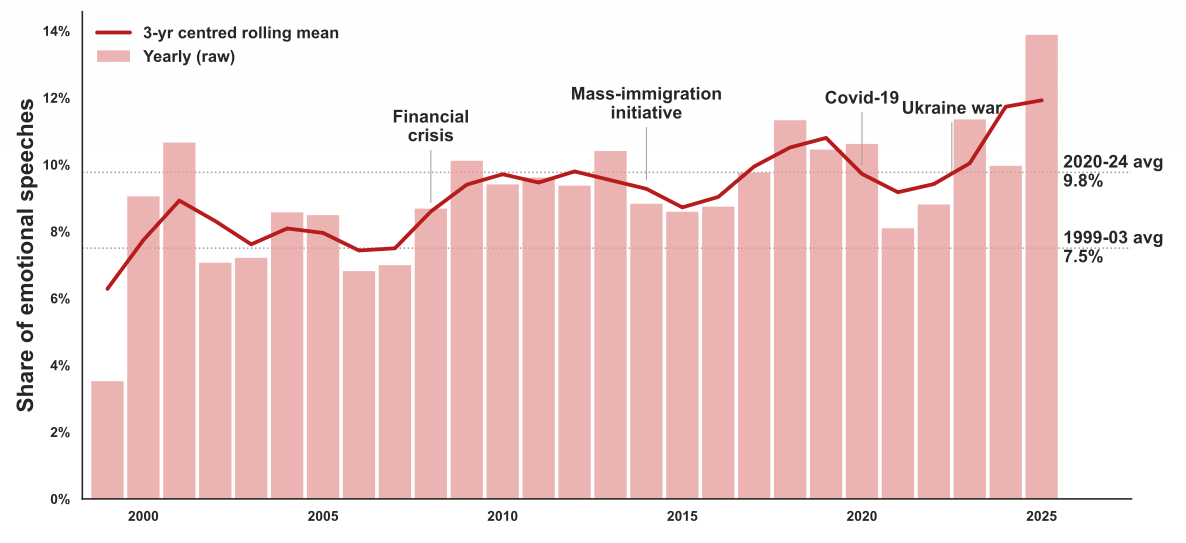
International crises produce direct emotional echoes. During the pandemic and the Ukraine war, fear-related language rose noticeably. The Council of States, however, tells a consistently calmer story, with emotional rhetoric running at roughly half the National Council's rate throughout the period, rising from a 1999-2003 average of 7.5% to 9.8% in 2020-2024, compared to 17.9% and 21.6% in the National Council. Enthusiasm, rather than anger, dominates there across most parties.
The Institutional role also shapes rhetoric. Transitioning to the Federal Council correlates with a reduction in emotional intensity. Amongst the current Federal Councillors, the emotional share has fallen from around 56% to 25% on average upon entering the Federal Council, where it remains stable. Younger MPs are also more emotional: those born after 1980 produce the highest share of any cohort at 26.6%, compared to 15.9% for those born in the 1940s, though whether this reflects a generational shift, or an age effect remains open. By illuminating the emotional strategies underlying parliamentary debate, this analysis contributes to greater transparency in democratic processes. Understanding how emotions are strategically employed, influenced by external events, and modulated by institutional roles provides citizens with deeper insight into the forces shaping policy decisions. In an era where democratic trust faces increasing pressure, such transparency represents a vital step toward a more informed and engaged electorate.