



Blog
18 June 2026A research collaboration between the University of Zurich student project and DemoSquare.
The method:
Has emotionality and polarization risen in the Swiss parliament between 1999 and 2026? To answer the research question, this project applied three techniques: AI classification, dictionary-based methods, and human validation.
We applied natural language processing to more than 180,000 Swiss parliamentary speeches across German, French and Italian. Using GPT-4o-mini, we tracked emotional content and tone at scale in two steps: first, the model distinguished between rational and emotional speeches. Second, for those flagged as emotional, one of eight dimensions of emotion was assigned: anger, hope, enthusiasm, fear, joy, sadness, pride, or disgust.
To ensure reliability, a subset of approximately 500 speeches was manually coded and compared against the LLM’s classifications. After several rounds of validation, the prompt was iteratively refined until the overlap between human and model reached a satisfactory score. In the final validated sample, the overall agreement rate reached 72%, meaning two human coders and the model agreed on whether a speech was emotional or not. For the specific dominant emotion, agreement was slightly lower at 61%, largely driven by the model's tendency to over-assign enthusiasm. The strongest agreement was for anger, where the three-way match reached 72%.
Each speech was also assigned to one of ten substantive topics using the Multilingual ParlaCAP model, a fine-tuned BERT-like classifier developed by Pungeršek et al. 20261. The topics ranged from foreign policy and healthcare to migration, energy and criminal justice2, giving us a structured lens through which to example not just how parliamentarians speak, but about what. Finally, descriptive statistics were used to trace how emotionality varied over time, between chambers and across party lines.
Our experience:
Working with this depth of data was both fascinating and demanding. Cleaning, adjusting prompts, and fine-tuning code showed us how important it is to be precise early on, because you will inevitably have to clean up your mistakes later. This Capstone gave us the chance to gain real hands-on experience alongside our studies, developing skills in coding and large language models that are becoming increasingly relevant in social science research. Once we got to explore the final datasets, the results were genuinely exciting, even if extracting meaningful insights sometimes felt like searching for a needle in a haystack. Each of us brought slightly different interests, slightly different approaches, and slightly different insights to the table. This gave us a varied perspective, which allowed us to have a more comprehensive view of parliamentary habitus.
One challenge that genuinely surprised us was just how hard it is to assign an emotion to a transcribed speech. Manual validation proved far more difficult than anticipated and was a reminder of how much commination lives outside the words themselves through hand movements, facial expressions, vocal pitch, tone, volume and more.
At the same time, the process showed how AI can help reduce the human bias that comes with watching or listening to a speaker you already have opinions about, making the process more consistent and scalable. That said, AI has yet to master the art of reading human emotions perfectly, and much remains hidden beneath the words that lies beyond current capabilities. The validity of our analysis relies as much on the consistency of inherent measurement errors across gender, party, and time as it does on the accuracy of raw classification. Capturing the full spectrum of human expression beyond text remains a fascinating open question for future research.
The team:
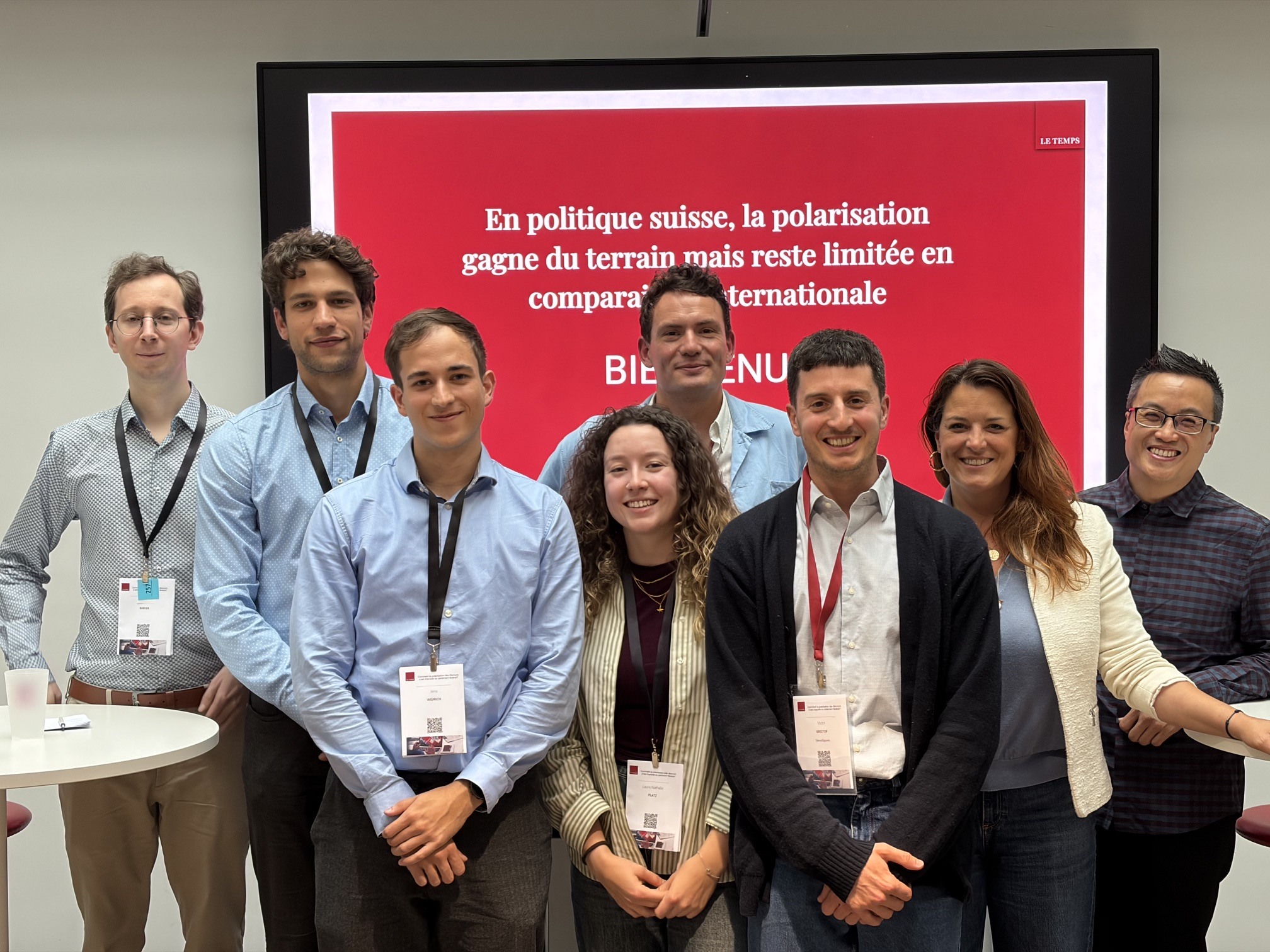
Four master students in Political Science (UZH) in the track Democracy, Development and International Politics: Jens Weirich, Laura Platz, Patrik György, Simon Birrer. Supervised by Hugo Subtil and Victor Kristof.
[1] Pungeršek, Kuzman, Taja Rupnik, Daniela Širinić, and Nikola Ljubešić. 2026. “Supercharging Agenda Setting Research: The ParlaCAP Dataset of 28 European Parliaments and a Scalable Multilingual LLM-Based Classification.” arXiv. https://arxiv.org/abs/2602.16516.
2Foreign Policy & Security; Defence & Military Budget; Tax & Public Finance; Criminal Justice & Rights; Healthcare; Energy & Environment; Agriculture & Food; Migration & Asylum; Social Policy & Labor; Economy & Infrastructure; Procedural Topics (were cut)